Key findings
Indian states are adopting AI faster than they are building the means to buy it well. The constraint is mostly not the technology. It is the route from a promising pilot to a contract the state can scale, own, audit and exit. Procurement rules designed for laptops and taxi services, awarded at the lowest price, are the wrong tool for systems whose performance is only known after testing and which change after delivery.
- The pilot-to-scale gap is the real bottleneck. Andhra Pradesh, among India's most advanced states, has identified 98 AI use cases and taken 29 to statewide production. That is a good ratio by global standards, but most identified uses have not yet reached citizens at scale.
- AI breaks five assumptions of conventional procurement: that performance can be specified in advance, that the vendor supplies the main inputs, that delivery is a one-time event, that switching is cheap, and that the lowest price is the best value.
- India's national AI stance is deliberately light-touch for private AI, but silent on the state's own purchases. Each department works out its own contract terms, evaluation and exit clauses.
- Other governments treat AI buying as a staged investment. The UK's “Scan, Pilot, Scale” approach and the US federal rules on AI acquisition (OMB M-25-22) both build in staged gates, data rights and protections against lock-in.
- Recommendation: states should adopt a five-part framework — problem and baseline first; staged contracts with gates agreed upfront; retained data, evaluation and portability rights; independent evaluation; and a shared procurement unit — backed by a government order that lets auditors accept value-based evaluation.
Executive summary
AI is moving from showcase pilots to the core of state administration. Andhra Pradesh now runs grievance redress, a WhatsApp service channel covering more than 1,100 services and a statewide data lake on AI-enabled systems. Other states are following. The Union government has signalled it will create an empanelment route for AI projects across central and state departments.
The way states buy AI has not kept pace. Public procurement in India rests on the General Financial Rules and the Government e-Marketplace (GeM), which are built to buy specified goods and services at the lowest price. That system works well for commodities and badly for AI, where the value of a system depends on local testing, on government data, and on the state's ability to change vendors later.
The costs of getting this wrong are rarely visible at the start. They appear later as pilots that never scale, vendors that cannot be replaced, models tuned on government data that the state does not own, and per-query bills that rise with global compute prices. They also appear as harms to citizens when a system that worked in one district fails in another, or for one language, and nobody tested for it.
This report proposes a procurement framework that states can adopt without new legislation. It draws on Indian precedent, notably Tamil Nadu's 2020 AI policy and NITI Aayog's Responsible AI principles, and on the experience of the UK and the US federal government.
Section 1India's state AI moment
Andhra Pradesh as a leading case
Andhra Pradesh offers the clearest view of where Indian states are heading. In July 2026 the state reported that it had identified 98 AI use cases across government, of which 29 were in statewide production.1 The scale of the deployed systems is significant:
| System | Function | Reported scale |
|---|---|---|
| Mana Mitra | WhatsApp-based citizen service channel | 1,126 services across 35 departments; 58.2 lakh citizens; 3.42 crore sessions |
| AI4PGRS | AI-assisted public grievance redressal | 17.6 lakh grievances processed |
| AWARE | Data and analytics platform | 61 use cases |
| State Data Lake | Integrated government data | 55 databases across 41 departments |
| RTGS Lens | Workflow monitoring | 506 workflows across 28 departments |
| Revenue One | Revenue administration platform | 19,000 officials 2 |
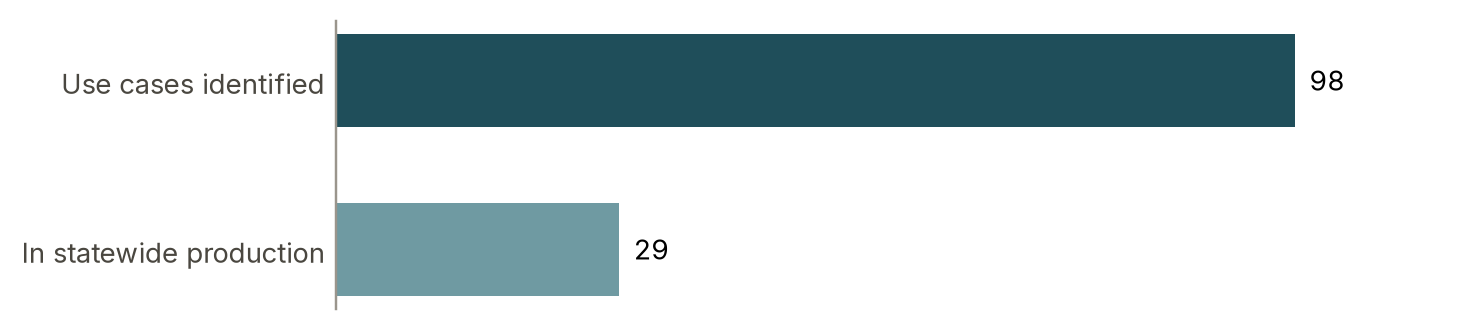
A 30% conversion rate from identified use case to statewide production is high by international standards; many governments struggle to take any pilot beyond a single site. But the gap between 98 and 29 still represents the main opportunity, and the main risk. The 69 use cases not yet at scale will be decided less by model quality than by whether contracts, evaluation and budgets allow them to grow, or force them to stop.
The Centre is building a channel
The Union government is also moving. In October 2026, the Minister for Electronics and IT said the government would use an empanelment approach rather than traditional tenders for AI procurement.3 Reports indicate that the plan is to empanel startups and companies to bid for AI projects across central and state departments.4 An empanelled pool would lower the cost of reaching qualified vendors. It would not, by itself, settle how departments should define problems, structure pilots, evaluate results or protect their data. Those are the questions this report addresses, and they are best answered before the empanelment terms are fixed.
Section 2Why AI is a different kind of purchase
Most public procurement assumes the buyer can specify the product in advance, compare bids on price, accept delivery once and replace the supplier if needed. AI breaks each of these assumptions.
| Conventional assumption | What is different with AI | Consequence if ignored |
|---|---|---|
| Performance can be specified before purchase | Whether a model works in a given district, language or workflow is only known after testing on local data | Specifications are guesses; pilots “succeed” without evidence |
| The vendor supplies the main inputs | Systems are trained, tuned and evaluated on government data and staff feedback | The state pays to rebuild value it created |
| Delivery is a one-time event | Models drift; vendors update underlying models; costs move with compute prices | A system accepted in month one behaves differently in month six |
| Switching suppliers is feasible | Workflows, data pipelines and staff habits form around one system | Lock-in; weak bargaining power at renewal |
| Lowest price is best value | Accuracy, error rates for vulnerable groups and long-run cost dominate | The cheapest bid becomes the most expensive over five years |
Performance cannot be known in advance
Whether a crop-disease model works in coastal Andhra, or a grievance classifier handles Telugu voice notes, can only be known by testing it on local data. A specification written before the pilot is largely a guess. Procurement that treats AI as a specified product therefore rewards confident claims rather than demonstrated performance.
The state supplies the most valuable input
AI systems for government are trained, tuned and evaluated on government data, and improved through the corrections of government staff. If the contract is silent on who owns the tuned model, the evaluation datasets and the accumulated prompts and corrections, the state can find itself paying to recreate value it produced.
Systems change after delivery
Models drift as the data they see changes. Vendors update or swap underlying foundation models. Usage-based pricing moves with global compute costs, which have risen sharply in 2026. A one-time acceptance test cannot capture a system that behaves differently six months later.
Lock-in compounds
Once a department's workflows, data pipelines and staff routines are built around one vendor's system, switching costs rise every month. The UK's procurement guidance names the risk directly: buyers should “avoid black box algorithms and vendor lock-in.”5
Lowest price is the wrong test
On GeM, purchases above ₹25,000 must follow price comparison, bidding or reverse auction, with the lowest price (L1) as the criterion.6 For commodity goods, that protects taxpayers. For AI, a bid that is cheap per licence may be expensive per correct decision, or may hide costs in data migration, retraining and exit.
Section 3India's current toolkit
GeM and the General Financial Rules
GeM is a genuine public-sector success. It connects more than 1.37 lakh buyer organisations with nearly 25 lakh sellers and has handled more than ₹20 lakh crore in cumulative procurement.7 Rule 149 of the General Financial Rules makes GeM mandatory for central government purchases of goods and services available on the platform, and most states have adopted it through their own orders.8 For standardised purchases it has reduced prices, shortened timelines and improved transparency.
The same features that make GeM effective for commodities limit it for AI: standard catalogue categories, price as the deciding criterion, and one-time acceptance. GeM can still be the channel for AI purchases. What it needs is AI-specific categories and contract terms.
National principles
NITI Aayog's Responsible AI paper (2021) recommended mandating responsible AI practices in public-sector procurement of AI systems. It also warned that the process “should not lead to administrative delays or simply exist as a mechanism to issue clearances.”9
The India AI Governance Guidelines (November 2025) favour voluntary measures, sectoral regulators and existing law over a new AI statute. They advise that frameworks should “avoid compliance-heavy requirements… unless deemed necessary.”10 That is a reasonable stance for regulating private AI. It leaves the state's own purchasing of AI largely unaddressed. MeitY has said it will publish a consultation paper on AI regulation; public procurement is a natural area for it to cover.
Tamil Nadu's 2020 policy: an Indian precedent
Tamil Nadu's Safe and Ethical AI Policy (2020) went further than any national document. It required departments to assess AI projects with a structured framework (TAM-DEF) and to score them on a DEEP-MAX scorecard covering diversity, equity, ethics, privacy, misuse protection, audit and cross- geography applicability. Departments were to consult the Centre of Excellence in Emerging Technologies at the Tamil Nadu e-Governance Agency before procuring AI, and systems were to be re- scored every six months.1112
The policy shows that an Indian state can write AI-specific procurement rules. A review of AI governance in India's federal system noted, however, that how far the policy has been implemented is “yet to be seen.”13 The lesson is that principles and scorecards are not enough. They need contract templates, a funded unit to apply them, and protection for officials who use them.
Section 4What other governments have learned
| Government / body | Approach | Lesson for Indian states |
|---|---|---|
| UK , Guidelines for AI Procurement (2020) | Ten principles: start with the problem, assess data before tendering, engage the market early, avoid 14 lock-in, plan for the full life cycle | Most failures are set up before the tender is published |
| UK , AI Opportunities Action Plan (2025) | “Scan, Pilot, Scale”: fast, light procurement for pilots, with controls added as spending grows; a central 15 function to scale proven pilots | Match the weight of process to the size of the bet |
| NHS AI Diagnostic Fund | £21 million to 12 imaging networks covering 66 trusts, so a tool is bought once and deployed widely | Buy together to scale together |
| US , OMB Memorandum M-25-22 (2025) | Federal AI acquisition rules: protections against vendor lock-in, data and model portability, limits on vendors training on agency data, and evaluation data 16 kept from vendors | Write data rights and exit into every contract |
| US , GovAI Coalition | Shared repository of AI contract templates and cooperative agreements usable by any public 17 agency | Smaller buyers gain bargaining power from shared terms |
The US federal rules in detail
M-25-22 is the most detailed recent example and closest to a model for India's states. Issued in April 2025 and applied to federal solicitations from October 2025, it directs agencies to include contract terms that prevent vendor lock-in, secure the agency's rights to its data and to models and outputs developed with it, and bar vendors from using non-public agency data to train commercial models without explicit consent.18 It also requires agencies to test performance on their own data, keeping evaluation data separate from the vendor. Each of these terms translates directly into Indian contract language.
The common thread
The governments furthest along treat AI procurement as a staged investment decision rather than a one-time purchase. They make pilots faster and cheaper than ordinary procurement, then raise scrutiny as spending and risk grow. They protect the buyer's data and freedom to switch from the start, when doing so costs little. And they share contract terms so that each agency does not negotiate alone.
Section 5A five-part framework for Indian states
The framework below can be adopted through executive orders, procurement manuals and model contracts. It needs no new legislation.
1. Start with the problem and a baseline
Every AI procurement should begin with a written problem statement and a measured baseline: for example, “Grievances take an average of X days to route, and Y% are misrouted.” Without a baseline, no pilot can show it worked, and scaling decisions default to enthusiasm or vendor relationships. The UK guidance asks buyers to explain why AI is relevant at all and to remain open to alternative solutions.19 Sometimes the right answer to a problem is a simpler rule or a better form, not a model.
2. Use staged contracts with gates agreed upfront
Replace the single tender with a gated contract. The criteria for moving between stages are agreed before the pilot begins, so vendors know what success means and officials have a defensible basis for expanding a contract without re-tendering.
Stage 0 · Define
Problem statement, baseline, data assessment and risk tier.
Gate: approval by department head and procurement unit
Stage 1 · Pilot
One district or office. Small budget, fast award, paid pilot.
Gate: measured gain over baseline; no major harms in independent review
Stage 2 · Expand
Several districts with different conditions and languages.
Gate: performance holds across contexts; cost per outcome within range
Stage 3 · Scale
Statewide rollout with ongoing monitoring.
Gate: published evaluation; exit and portability plan tested
Risk tiering should set the weight of each gate. A model that drafts internal summaries needs lighter review than one that affects eligibility for a welfare scheme. A simple three-tier classification — internal productivity, citizen-facing information, and decisions about individuals — would let departments move quickly on low-risk uses while concentrating review where errors harm people.
3. Keep what the state creates
Model contract terms should guarantee the state's rights in five areas. These clauses cost little to include at the start and are nearly impossible to negotiate later.
| Right | Model clause intent |
|---|---|
| Data ownership | All government data, and data generated in delivering the service, remains state property; returned in documented formats at contract end |
| Evaluation sets | Test datasets and benchmarks built during the project belong to the state and are withheld from the vendor's training |
| Portability | Fine-tuned models, prompts, configurations and workflow logic delivered in usable form at exit; open, documented interfaces |
| No training without consent | Vendor may not use non-public government data to train or improve commercial models without written permission |
| Price protection | Caps on price increases for usage-based services, or pricing tied to a published index within bounds |
4. Evaluate independently and publish the results
Before statewide rollout, an evaluator not paid by the vendor should test the system for accuracy across languages and districts, error rates for vulnerable groups, and cost per outcome. Results should be published, including failures. Publishing failed pilots is what stops the next state from repeating them. States could build a shared, empanelled pool of independent evaluators, including universities and technical institutions, rather than each department contracting its own.
5. Build a shared AI procurement unit
Most departments buy AI rarely. A small specialist unit, at state level or shared across states, could maintain model contracts, run or commission evaluations, track which pilots scaled and why, and negotiate as a single buyer for common needs such as speech recognition in regional languages or document processing. Andhra Pradesh already has an institutional base in its Real Time Governance Society, which runs the State Data Lake. Tamil Nadu's Centre of Excellence in Emerging Technologies was designed for a similar role. A cross-state unit, perhaps hosted with the IndiaAI Mission, could serve smaller states that cannot staff their own.
Section 6Implementation
The audit problem
The deepest constraint on better AI procurement is not knowledge but incentives. Officials choose the lowest price because it is the safest choice to defend in an audit. Guidance alone will not change this. The framework works only if the state's finance department and its audit authorities formally accept value-based evaluation for AI, for example quality-and-cost-based selection with published weights, and accept that some well-run pilots will fail. That requires a written government order.
A twelve-month roadmap
| Timing | Action | Owner |
|---|---|---|
| Months 0–3 | Issue a government order on AI procurement: risk tiers, staged contracts, value-based evaluation; designate a procurement unit | IT department, finance department |
| Months 0–3 | Publish model contract clauses (Annex) and require them in new AI contracts | Procurement unit, law department |
| Months 3–6 | Empanel independent evaluators; publish an evaluation protocol | Procurement unit |
| Months 3–6 | Audit existing AI contracts for data rights and exit terms; renegotiate at renewal | Departments, procurement unit |
| Months 6–12 | Run two or three pilots under the new framework, including at least one decision-affecting use | Selected departments |
| Month 12 | Publish a first annual report on AI procurement: pilots, scaling decisions, failures and costs | Procurement unit |
What to measure
States adopting the framework should publish a small set of indicators:
- the share of pilots reaching statewide production, and the median time taken;
- cost per outcome, such as cost per correctly resolved grievance, rather than cost per licence;
- error rates by language, district and vulnerable group for decision-affecting systems;
- the number of contracts with tested exit and portability plans.
Section 7Objections and responses
“This will slow everything down.”
It can, if gates become clearance rituals, which is exactly NITI Aayog's warning. The design answer is to make pilots faster than today, through small budgets and quick awards, and to add scrutiny only as spending and risk grow. The aim is less process where risk is low and more where it is high.
“Departments lack the capacity to run evaluations.”
True, which is why evaluation should sit with a shared unit or an empanelled pool of independent evaluators rather than with each department.
“Startups cannot survive long, staged contracts.”
Staged contracts help startups if each stage is paid promptly and scaling criteria are clear. The UK plan suggests compensating startups for each stage they pass. The bigger threat to startups is the current pattern of unpaid pilots that never convert.
“Owning models and data is unrealistic with frontier AI providers.”
For general-purpose foundation models, the state will not own the model. It can still own its data, its evaluation sets, its tuning and its right to switch. Portability, not ownership of the underlying model, is the realistic goal, and it is the one the US federal rules pursue.
“States should wait for national rules.”
National rules may come, and states that have tested a framework will shape them. Waiting has a cost: every contract signed now without data rights or exit terms will be hard to reopen.
Section 8Conclusion
States that learn to buy AI well will deliver more with every rupee and keep the value they create. States that do not will accumulate pilots. The tools already exist — staged contracts, retained rights, independent evaluation and shared procurement — and Indian states, from Tamil Nadu's 2020 policy to Andhra Pradesh's current deployments, have already shown both ambition and capacity. What is missing is a decision to treat AI procurement as a policy question rather than an administrative task, and a government order that lets officials act on it.
AnnexModel clause checklist
The checklist below is intended as a starting point for state law and IT departments drafting AI contracts. It is not legal advice and should be adapted to each state's procurement rules.
| Area | Clause | Pilot | Statewide |
|---|---|---|---|
| Problem and baseline | Written problem statement; baseline metrics and measurement method attached to contract | Required | Required |
| Success criteria | Quantified criteria for moving to the next stage, agreed before award | Required | Required |
| Data ownership | State owns input data and data generated in service delivery; returned on exit | Required | Required |
| Training restriction | No use of non-public state data to train commercial models without written consent | Required | Required |
| Evaluation data | State-held test sets withheld from vendor; vendor cooperates with independent testing | Recommended | Required |
| Model change notice | Advance notice and re-testing when the underlying model or version changes | Recommended | Required |
| Portability | Delivery of tuned models, prompts, configurations and documentation at exit | Recommended | Required |
| Interfaces | Open, documented APIs; no proprietary data formats without export tools | Recommended | Required |
| Price protection | Cap on usage price increases or index-linked pricing within bounds | Optional | Required |
| Human review | Human review of adverse decisions about individuals; accessible appeal route | Required if decision- affecting | Required if decision- affecting |
| Logging and audit | Logs of inputs, outputs and overrides retained and accessible to auditors | Required | Required |
| Exit plan | Documented transition plan, tested before statewide rollout | Optional | Required |
| Payment terms | Paid pilots; payment within a fixed period after each gate | Required | Required |
About this report
India 2035 Research is an independent research initiative on AI as public infrastructure in India. This report draws on official releases, government orders, international guidance and press reporting available as of 24 October 2026. Corrections and comments are welcome at rahul@india2035.ai.
Sources
- New Indian Express, “Andhra Pradesh to integrate artificial intelligence into core of governance,” 8 July 2026. newindianexpress.com
- India Today, “Andhra Pradesh's Mana Mitra WhatsApp governance platform offers 1,126 services,” 8 July 2026. indiatoday.in
- MediaNama, “MeitY invites AI compute providers to supply 10,000 GPUs under IndiaAI Mission,” 13 October 2026. medianama.com
- ET Datacenters, “India to issue AI regulation paper, expands GPU capacity,” October 2026. datacenters.economictimes.indiatimes.com
- OECD, Generative AI experimentation in government, 2026, summarising UK guidance. oecd.org
- Press Information Bureau, GeM factsheet. pib.gov.in
- Press Information Bureau, GeM factsheet, 2026. pib.gov.in
- Government e-Marketplace, GeM Handbook. assets-bg.gem.gov.in
- NITI Aayog, Responsible AI: Part 2, Operationalizing Principles for Responsible AI, August 2021. niti.gov.in
- Press Information Bureau, India AI Governance Guidelines, November 2025. pib.gov.in
- Tamil Nadu e-Governance Agency, Safe and Ethical AI Policy, G.O. (Ms.) No. 24. tnega.tn.gov.in
- MediaNama, “Tamil Nadu AI policy 2020,” September 2020. medianama.com
- Forum of Federations, Government with Algorithms: Managing AI in India's Federal System, Occasional Paper 70, 2025. forumfed.org
- GOV.UK, Guidelines for AI procurement, 2020. gov.uk
- GOV.UK, AI Opportunities Action Plan, January 2025. gov.uk
- White House, OMB M-25-22, Driving Efficient Acquisition of Artificial Intelligence in Government, April 2025. whitehouse.gov
- OECD, Governing with Artificial Intelligence: AI in public procurement, June 2025. oecd.org
- Ropes & Gray, “White House issues guidance on use and procurement of artificial intelligence technology,” April 2025. ropesgray.com
- OECD, Governing with Artificial Intelligence, 2025. oecd.org