Key findings
India's digital public infrastructure has produced one of the world's richest records of how a developing economy works. Using that data to build AI suited to Indian languages and conditions is now official policy direction. The legal and institutional framework for doing so safely does not yet exist, and India's own evidence shows how data systems built for efficiency can exclude the people they are meant to serve.
- The law does not address model training. The DPDP Act's research exemption covers processing not used for decisions about individuals. It does not say whether, or when, training an AI model qualifies.
- Research becomes deployment. A model trained for research is valuable precisely because it can later be used on individuals. Nobody is assigned to check when that line is crossed.
- Nobody grants or supervises access. Each data holder decides alone, with no permit system, no public register and no common standard.
- India has the technology; Europe has the institutions. India's DEPA for Training keeps sensitive data in confidential clean rooms. The EU's Health Data Space and Finland's Findata show how independent access bodies issue and supervise permits.
- The main risk is exclusion, not leakage. A rigorous Jharkhand evaluation found that stricter biometric authentication raised beneficiaries' costs and cut benefits for those with incomplete records. AI trained on administrative data and used for targeting could repeat that pattern at greater scale.
- Recommendation: clarify the law on training; create independent data access bodies, starting with health and agriculture; make compute-to-data the default; draw a firm line between training and decisions about individuals; publish a register of access; and share the benefits of models trained on public data.
Executive summary
AI models trained mostly on English-language data from wealthy countries perform worse on Indian languages, diseases, soils and informal economic patterns. India's public data, from health encounters to farm records to welfare transactions, could close that gap. The India AI Governance Guidelines endorse this direction, calling for DEPA-style consent architectures to support responsible AI training.
Three gaps stand in the way. The law is silent on AI. The Digital Personal Data Protection (DPDP) Act's research exemption was not written with model training in mind. Access is unmanaged. Every ministry, state department and hospital network decides for itself who may use its data and on what terms. Uses are not separated. Nothing stops a model trained under a research exemption from later being used to score, flag or exclude individuals.
The stakes are concrete. India's best evidence on data-driven welfare comes from a large randomised evaluation in Jharkhand, which found that stricter authentication raised costs for beneficiaries and reduced benefits for those whose records were incomplete. AI-based targeting systems, such as the vulnerability scoring proposed in Andhra Pradesh, would rely on the same kinds of records.
This report argues for a governed middle path between locking public data away and opening it up. India already has the technical building blocks in DEPA for Training. What it lacks are the institutions: an independent body to grant and supervise access, and clear rules on what models trained on public data may be used for. The DPDP Act's substantive provisions take effect in May 2027. Building these institutions before then is the opportunity.
Section 1The opportunity and its limits
Why public data matters for Indian AI
General-purpose AI models learn from what is available online, which is overwhelmingly English and drawn from high-income countries. They know less about crop diseases in Vidarbha, the clinical presentation of tuberculosis in Indian primary care, or the cash flows of a kirana store. India's digital public infrastructure has generated exactly this kind of data, at population scale, under public authority. Used well, it could make Indian AI more accurate for Indian conditions and less dependent on foreign models.
Policy has moved in this direction. The India AI Governance Guidelines of November 2025 call for leveraging digital public infrastructure and for “DEPA-style consent architectures to support responsible AI training.”1
AIKosh: volume is not value
The IndiaAI Mission's dataset platform, AIKosh, has grown rapidly. It listed about 300 datasets at launch in March 2025,2 7,541 by February 20263 and more than 16,000 datasets and 372 models by October 2026.4
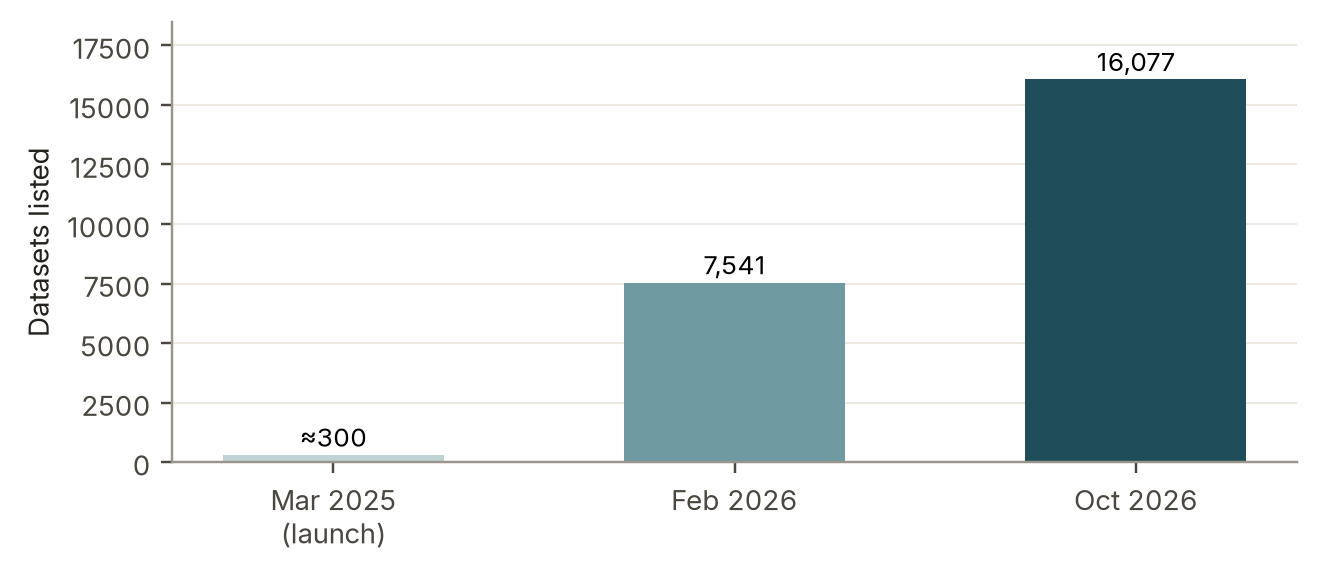
Counting datasets says little about their usefulness. Independent reviewers have noted that there is “no data showing the usefulness of this content or whether it was actually helpful in building projects.”5 More fundamentally, the most valuable public data — identifiable health records, welfare transactions, land and tax data — cannot be published on a portal at all. It needs a different route: controlled access, under supervision, for defined purposes.
Section 2The legal gap
What the DPDP framework says
The Digital Personal Data Protection Act, 2023 and its Rules, notified on 13 November 2025,6 are India's main data protection framework. Most substantive provisions take effect on 13 May 2027.7
Aug 2023
DPDP Act passed by Parliament.
Nov 2025
DPDP Rules notified; AI Governance Guidelines released.
Late 2026
MeitY consultation paper on AI regulation expected.
May 2027
Substantive obligations take effect. Window for institution-building closes.
Section 17(2)(b) exempts processing “necessary for research, archiving or statistical purposes if the personal data is not to be used to take any decision specific to a Data Principal,” subject to prescribed standards.8 Rule 16 and the Second Schedule set those standards: lawful processing, data minimisation, accuracy, limited retention and reasonable security safeguards.9
Three problems
The law never mentions AI
Neither the Act nor the Rules uses the words “artificial intelligence” or “machine learning.”10 Whether training a model counts as “research” is left to interpretation by each data holder and, eventually, the Data Protection Board. That uncertainty cuts both ways: cautious holders refuse legitimate requests, while others proceed on generous readings that may not survive challenge.
Research becomes deployment
The exemption depends on data not being used to take decisions about individuals. But a model trained for research is commercially and administratively valuable precisely because it can later be applied to individuals: to score credit, flag patients or target welfare. Lawyers already advise that the exemption may be lost once outputs are used for individual decisions.11 The law does not say who checks, or when.
Nobody grants or supervises access
Each data holder, whether a ministry, a state department or a public hospital network, decides alone whether to share data for AI development. There is no permit system, no public register of who accessed what, no common technical standard and no consistent treatment of similar requests.
Section 3Models that work
DEPA for Training (India)
The Data Empowerment and Protection Architecture (DEPA) for Training, developed with iSPIRT and launched in 2023, is a technical and legal design for training AI on sensitive data without copying it.12 It works in four steps:
- Registration: data providers register datasets and their permitted uses.
- Electronic contracts: data providers, model developers and other parties sign digital contracts setting permitted uses and privacy budgets — limits on how much can be learned about any individual.
- Confidential clean rooms: training runs inside hardware-isolated environments that can prove what code ran on the data. The model developer receives the trained model, not the raw data.
- Audit: every training run is logged and can be checked against the contract.13
The core idea is that the model comes to the data, not the other way round. This removes the largest privacy risk of AI development, the creation of copies of sensitive data outside the holder's control.
The European Health Data Space
The EU's 2025 regulation on the European Health Data Space (EHDS) focuses on institutions. Each member state must designate a health data access body to review applications and issue data permits. Data is accessed only in pseudonymised or anonymised form inside secure processing environments; personal data cannot be downloaded. Certain uses, including advertising and decisions detrimental to individuals, are prohibited.14 Training and testing AI systems are explicitly permitted purposes, and individuals have a simple, reversible right to opt out of secondary use.15
Findata (Finland)
Finland created a working example years before the EHDS. Findata, established in 2019 under the Act on the Secondary Use of Health and Social Data (552/2019), grants permits for secondary use of health and social data held by multiple public bodies. It compiles and pseudonymises the data and provides it inside Kapseli, a secure processing environment. It operates alongside the National Institute for Health and Welfare but separately from the Institute's other activities.1617 That separation between the permit authority and the data users is the institutional feature India most lacks.
| Feature | DEPA for Training | EHDS | Findata | India today |
|---|---|---|---|---|
| Legal basis | Contracts within existing law | EU regulation | National statute | DPDP research exemption, untested for AI |
| Who grants access | Data provider via e-contract | Designated access body | Independent permit authority | Each data holder alone |
| Where computation happens | Confidential clean room | Secure processing environment | Kapseli secure environment | Varies; often copies shared |
| AI training | Core purpose | Explicitly permitted | Permitted within purposes | Unclear |
| Individual opt-out | Through consent design | Yes | Set by national law | Not defined for research |
DEPA supplies the technology. The European models supply the institution. India needs both.
Section 4The critics are partly right
Evidence from Jharkhand
Any case for using public data must face India's own evidence on exclusion. The most rigorous comes from a randomised evaluation of Aadhaar-based biometric authentication in Jharkhand's public distribution system, which supplies subsidised food grain to 15 million beneficiaries. Authentication alone did not reduce leakage. The study's authors report that the zero average impact “masked a 10% reduction in benefits for the 23% of beneficiaries who had not linked an Aadhaar card to benefit rolls, with 2.8% receiving no benefits at all,” and that beneficiaries' transaction costs rose by an average of 17%.18 A different measure, reconciliation of transaction records, did sharply reduce leakage.
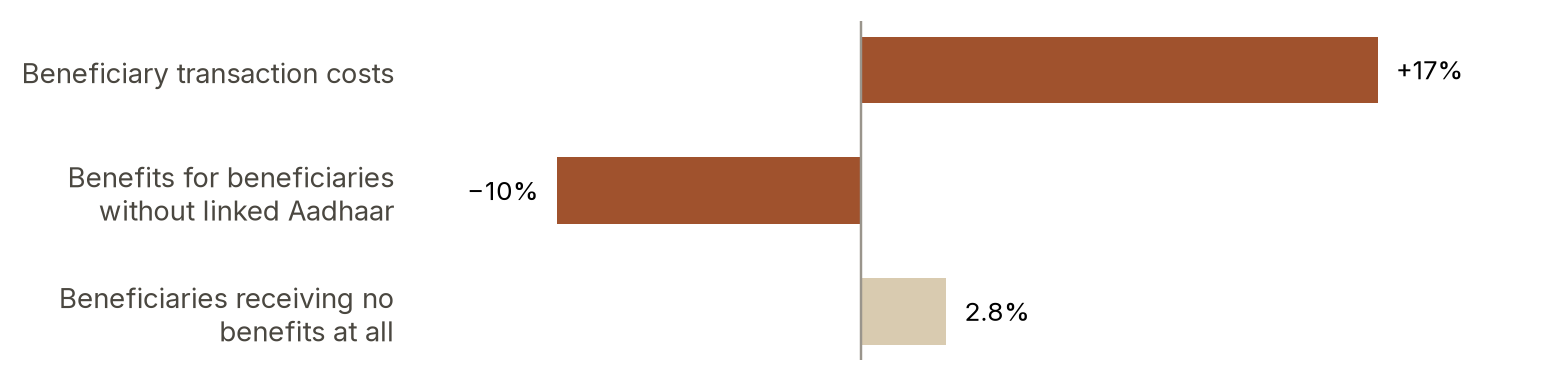
A related survey found that about 88% of ration cards cancelled in study districts belonged to genuine households.19 One of the study's authors summarised the evidence this way: “to an extent, both supporters and critics of Aadhaar for service delivery are correct.”20
The lesson for AI
The greatest risk from using public data for AI is not that training data leaks. It is that a model trained on administrative records is then used to make decisions about people, with errors that fall hardest on those whose records are incomplete — often the poorest, most mobile and least connected. Those same people are least able to contest an automated decision.
This is no longer hypothetical. Andhra Pradesh's proposed Family Benefit Management System would develop “AI-based vulnerability scores to improve targeting of government schemes.”21 Better targeting is a legitimate goal, and it may well reduce exclusion if designed carefully. It is also exactly where data governance and welfare exclusion meet.
Other objections that deserve weight
- Surveillance. Infrastructure that combines datasets for AI also creates the means for state profiling. Clean rooms limit copying but do not by themselves limit purpose.
- Consent is often not meaningful. Individual consent rarely reflects real choice when a welfare benefit depends on it.
- Value capture. Public data could end up enriching a small number of private model developers, with little return to the public that generated it.
Section 5A tiered model for access
Not all public data carries the same risk, and a single rule for all of it would be either too loose or too tight. A tiered model matches the safeguards to the risk.
| Tier | Data | Access route | Permitted uses |
|---|---|---|---|
| 1. Open | Non-personal and aggregated data: weather, soil maps, published statistics, public documents | Published on AIKosh or departmental portals under open licence | Any lawful use |
| 2. Controlled | De-identified records with residual re- identification risk: anonymised health encounters, crop insurance claims | Permit from access body; compute-to- data in clean room; logged runs | Research and model training for approved purposes |
| 3. Restricted | Identifiable or highly sensitive data: welfare eligibility, detailed health records | Permit plus ethics review; clean room only; privacy budget enforced | Approved public-interest research; no direct export of models without review |
| Decision use | Any model applied to individuals | Separate impact assessment and approval, regardless of training tier | Only with group-level error testing, human review and appeal |
Section 6Six proposals
1. Clarify the law on model training
MeitY should issue guidance, or amend the DPDP Rules, stating when model training qualifies under the research exemption and when it does not. The guidance should define training, fine-tuning and evaluation; set out what makes a use “specific to a Data Principal”; and specify that the exemption does not carry over to deployment. The AI Governance Guidelines already recommend clarifying how AI development is treated under the DPDP Act. MeitY's forthcoming consultation paper on AI regulation is a natural vehicle.
2. Create independent data access bodies
Start with health and agriculture, where data is rich, the public benefit is clear and international models exist. The body granting access should be separate from the departments that use the data or deploy models, as Findata is separate from the institute it sits beside. It should handle applications, issue permits, operate or certify secure environments and enforce conditions. States could host their own bodies for state-held data, or join a national one.
3. Make compute-to-data the default
For Tier 2 and Tier 3 data, use should take place only inside clean-room environments such as those designed under DEPA for Training, with logged, auditable runs and enforced privacy budgets. Copying raw data out should be the rare, justified exception. This also links to compute policy: public compute capacity under the IndiaAI Mission could host certified clean rooms.
4. Draw a bright line between training and decisions
A model trained under the research exemption should not be used for individual eligibility, scoring or enforcement decisions without:
- a separate, published impact assessment;
- testing for error rates among vulnerable groups, including those with incomplete records;
- human review of adverse decisions;
- a fast, accessible appeal route, including offline options.
Jharkhand shows why fallback routes are not optional. Where an automated system cannot verify someone, the default should be to continue the benefit while the case is resolved, not to stop it.
5. Publish a public register
List every access permit, its purpose, the user, the data tier and the results, including models produced. The EU requires such transparency for data permits. A register lets researchers, journalists and Parliament see how public data is being used, and makes misuse easier to detect.
6. Share the benefits
Models trained substantially on public data should carry public-interest licence terms. Options include free or low-cost use by government, universities and civil society; open release of weights for models trained mainly on public data; or a royalty paid into a fund for public data infrastructure. The aim is that the public that generated the data shares in what is built from it.
| Proposal | Owner | Instrument | Timing |
|---|---|---|---|
| Clarify law on training | MeitY | Guidance or Rules amendment | Before May 2027 |
| Independent access bodies | MoHFW, Agriculture, states | Executive order; later statute | Pilot within 12 months |
| Compute-to-data default | Access bodies, IndiaAI | Permit conditions; certified clean rooms | With first permits |
| Training–decision line | MeitY, line departments | Guidance; scheme guidelines | Before any AI-based targeting goes live |
| Public register | Access bodies | Online register | With first permits |
| Benefit sharing | IndiaAI, access bodies | Standard licence terms | Within 12 months |
Section 7Open questions
This report does not resolve several hard questions, each of which needs consultation with privacy advocates, welfare researchers and state governments, not only technologists:
- Opt-out for welfare data. Is individual opt-out workable where the people most at risk may be least able to use it? Would a collective safeguard, such as mandatory group-level testing, protect them better?
- Funding independence. How can access bodies be funded without depending on fees from the data users they supervise?
- Federal allocation. Should states or the Centre hold access authority for data that states collect under central schemes?
- Private data. Should private holders of data generated through public infrastructure, such as payment apps, be brought into the same framework?
Section 8Conclusion
India's choice is not between locking public data away and opening it up. It is between unmanaged access, where each department decides alone and errors are found after harm, and governed access, where institutions, technical safeguards and clear limits on use come first. The technology for governed access is being built in India. The institutions are not. Building them before the DPDP Act's substantive provisions take effect in May 2027 is the opportunity.
About this report
India 2035 Research is an independent research initiative on AI as public infrastructure in India. This report draws on legislation, official releases, academic research and press reporting available as of 24 October 2026. It is not legal advice. Corrections and comments are welcome at rahul@india2035.ai.
Sources
- Khaitan & Co, ERGO: India AI Governance Guidelines, 11 November 2025. khaitanco.com
- IMPRI, “AIKosh portal under IndiaAI Mission,” 2025. impriindia.com
- Press Information Bureau, IndiaAI background note, February 2026. static.pib.gov.in
- AIKosh, IndiaAI datasets platform, accessed October 2026. aikosh.indiaai.gov.in
- IMPRI, “AIKosh portal under IndiaAI Mission,” 2025. impriindia.com
- DSCI, Digital Personal Data Protection Rules, 2025. dsci.in
- Legal500, “How does the DPDP Act regulate AI training and automated decision-making in India?”. legal500.com
- DPDP Act 2023, Section 17. dpdpacts.com
- Lakshmikumaran & Sridharan, DPDP Rules: research exemption. dpdp.lkslaw.com
- dpdprules.org, frequently asked questions. dpdprules.org
- Legal500, “AI training data under India's DPDP regime: compliance challenges and strategies”. legal500.com
- Digital Impact Alliance, AI x DPI case study: DEPA, May 2026. dial.global
- iSPIRT, DEPA Training technical updates. pn.ispirt.in
- EUR-Lex, Summary of the European Health Data Space Regulation. eur-lex.europa.eu
- European Commission, European Health Data Space Regulation. health.ec.europa.eu
- Findata, About Findata. findata.fi
- Findata, Legislation. findata.fi
- Sukhtankar, S., “Balancing corruption and exclusion: Incorporating Aadhaar into PDS,” Ideas for India, April 2020, summarisingMuralidharan, Niehaus and Sukhtankar (2020). ideasforindia.in
- The Wire, “Aadhaar, PDS and ration cards in Jharkhand”. m.thewire.in
- Indian Express, interview with Karthik Muralidharan. indianexpress.com
- Telangana Today, “Andhra's Mana Mitra WhatsApp governance platform expands to offer 1,126 govt services,” July 2026. telanganatoday.com